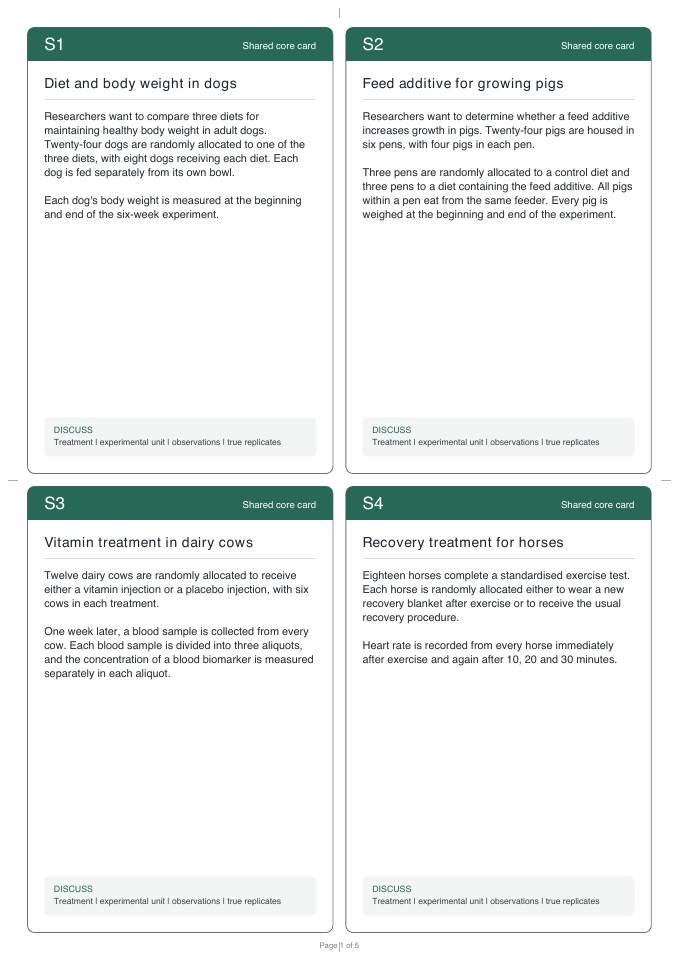
01-01 · Experimental unit card swap — cards (PDF)
Identify experimental units and discuss replication using the case cards.
Activities are numbered by teaching unit and their order within that unit. Open an activity for its instructions and any R scripts or other downloads. Use the teaching unit filter to find activities for a particular part of the course. The Open PDF buttons open the printable activity materials.
Identify experimental units and discuss replication using the case cards.
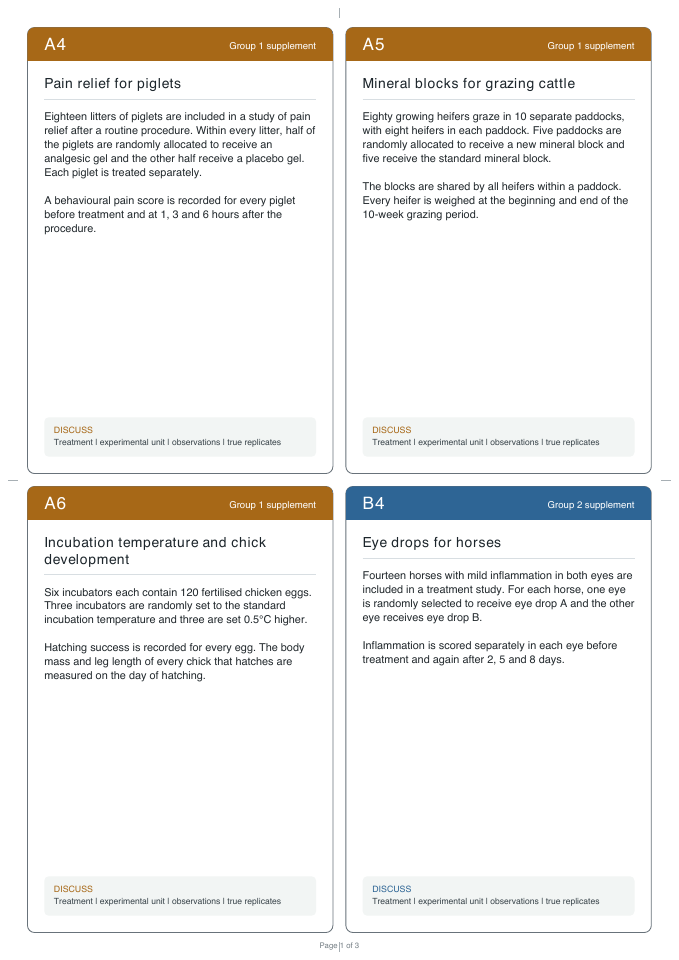
Practise identifying experimental units with additional cases.
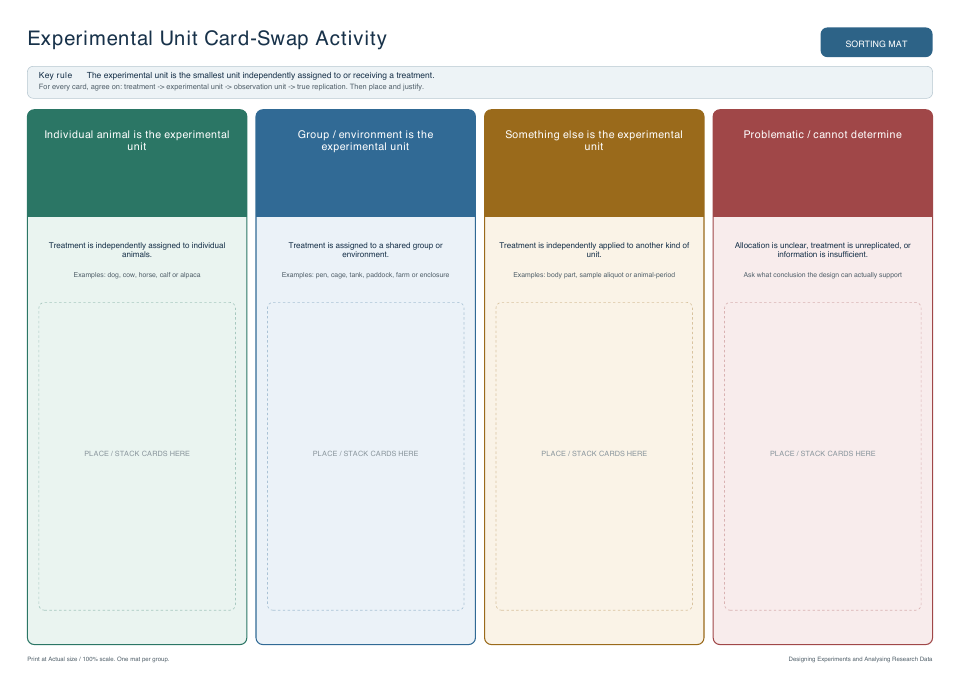
Use the A3 mat to organise your group’s case cards.
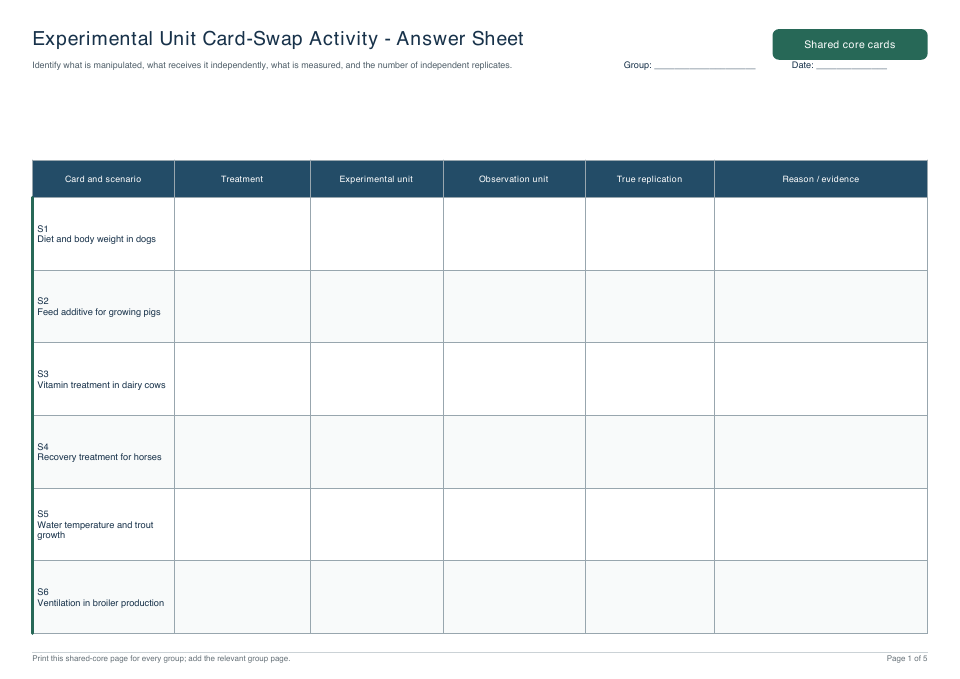
Record your group’s answers and reasoning.
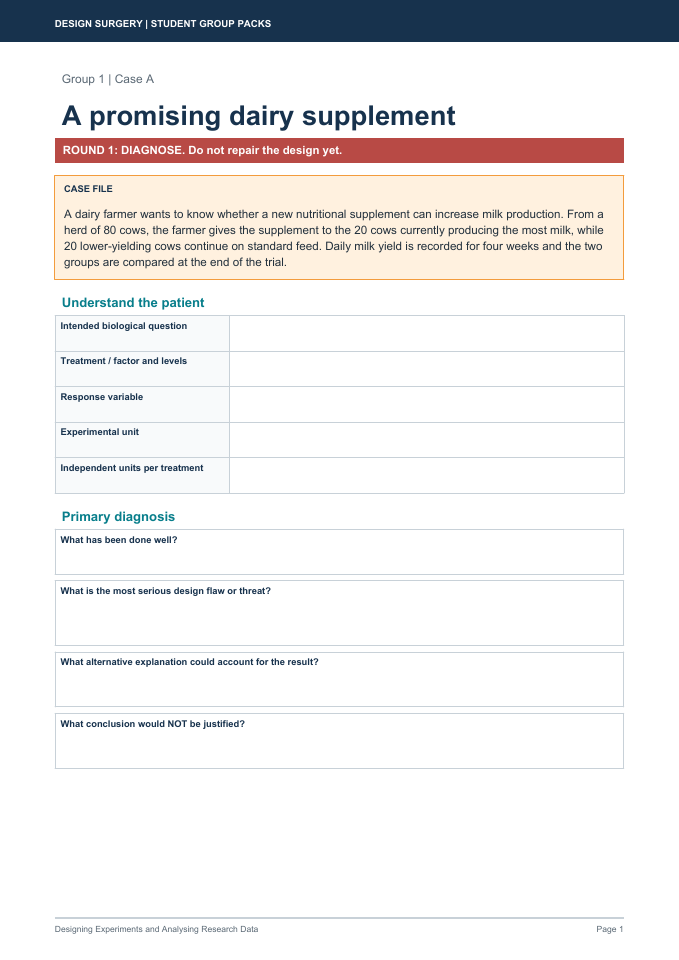
Diagnose experimental designs and propose improvements in your group.
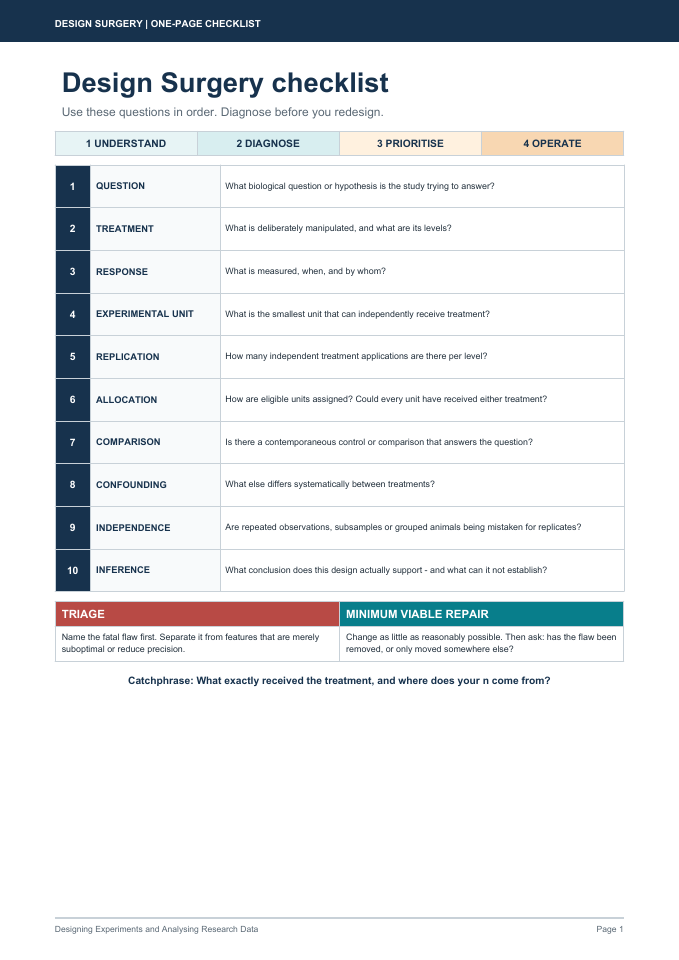
Check experimental units, replication, allocation and sources of bias.
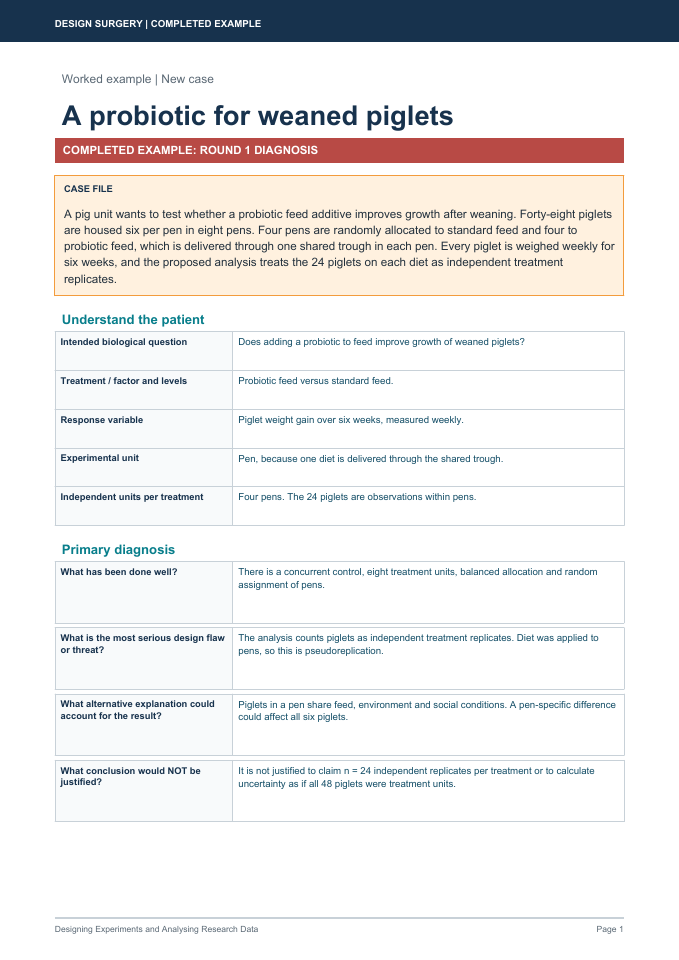
Review a worked example of the design surgery activity.
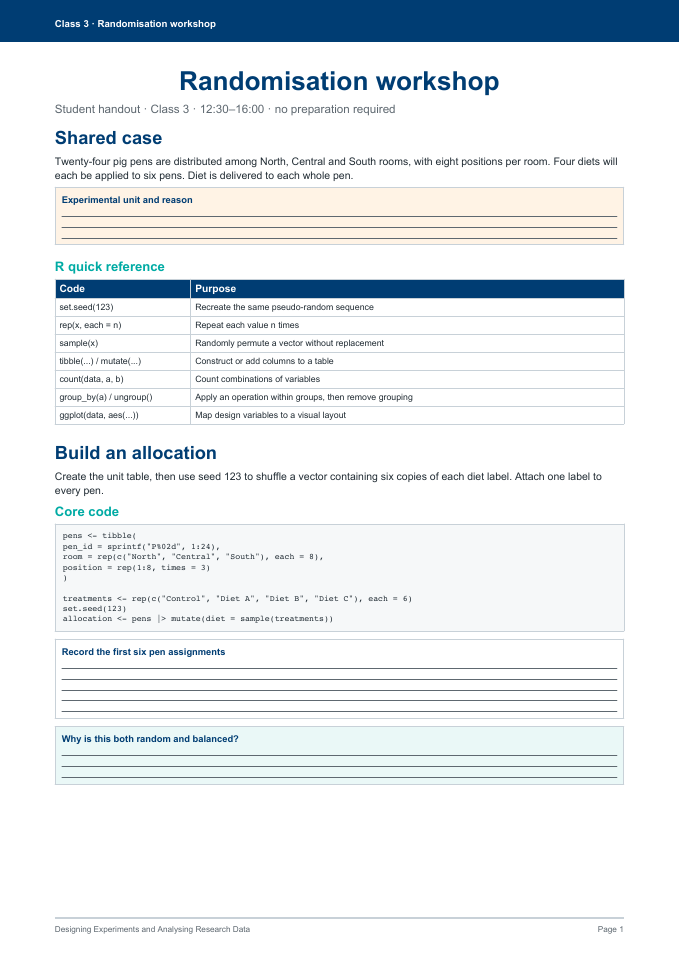
Follow the shared case and plan a reproducible treatment allocation.
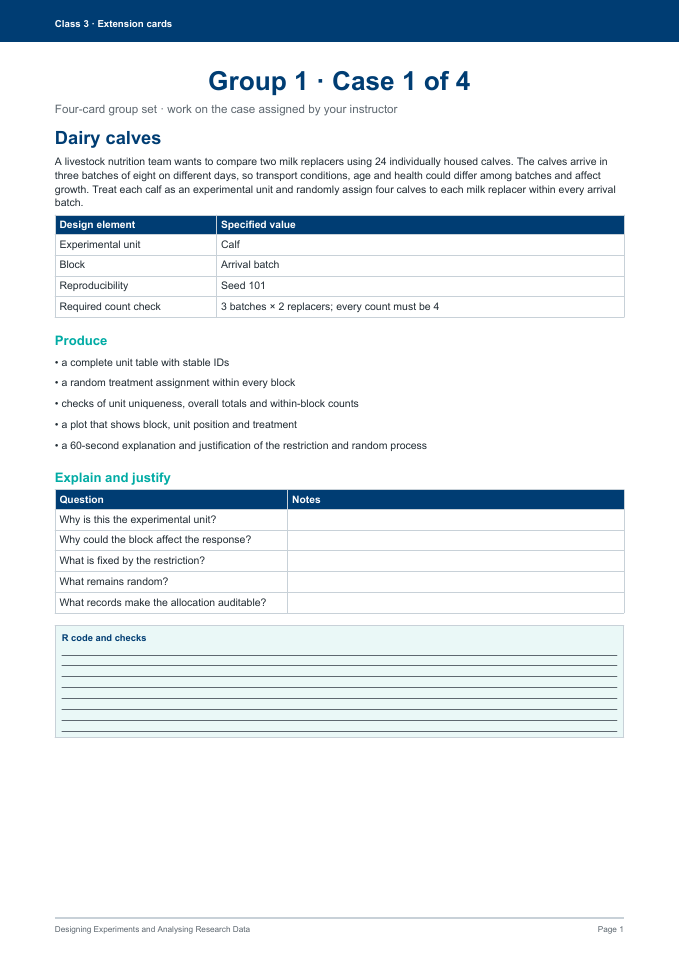
Apply randomisation within blocks to your group’s extension case.
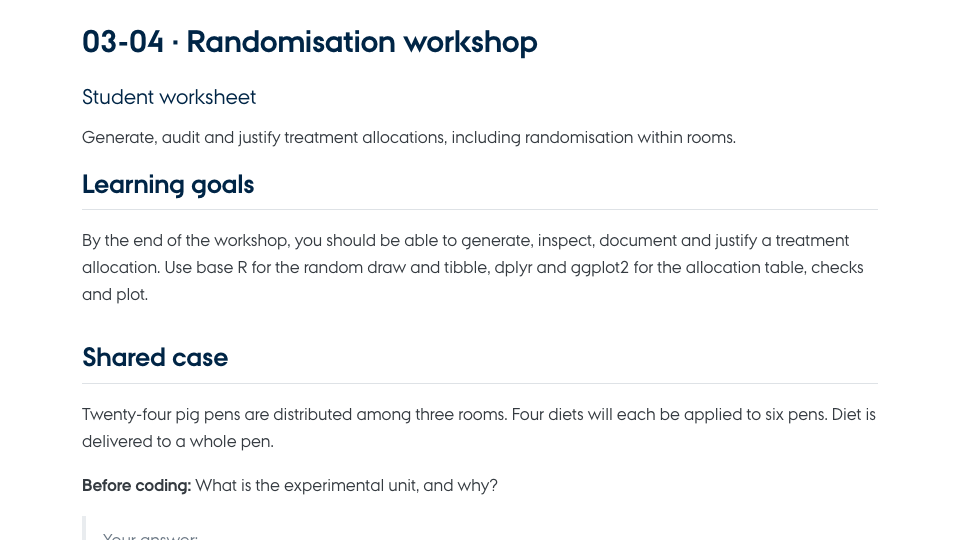
Generate, audit and justify treatment allocations, including randomisation within rooms.
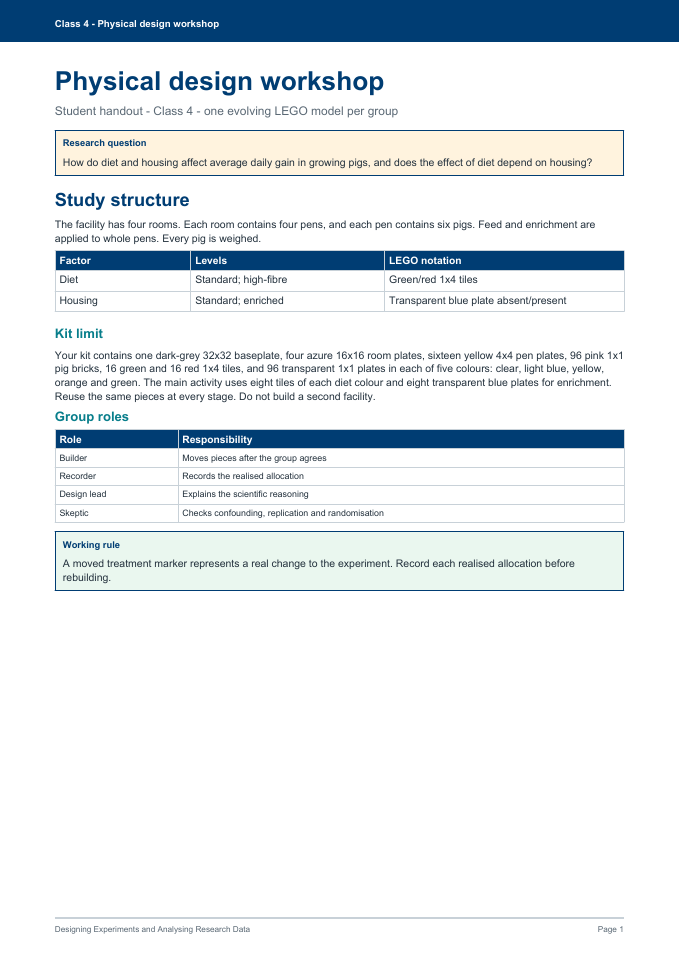
Build and compare blocked and factorial experimental designs.
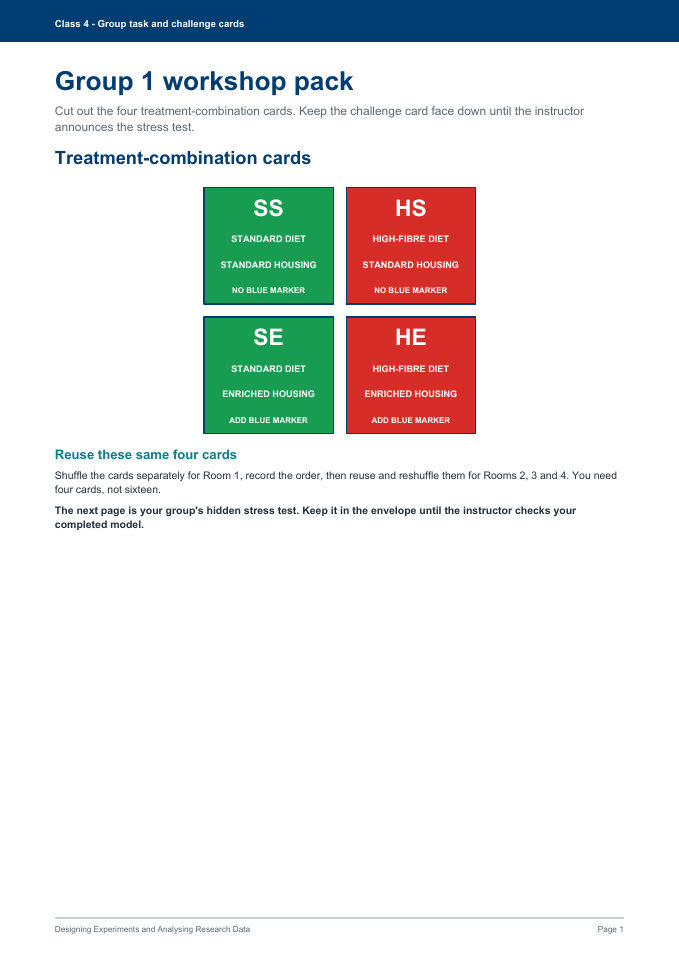
Use the group tasks and optional challenges during the physical workshop.
Build a blocked allocation and simulate two datasets using a supplied GLM.
Explain model assumptions, check your R simulation and prepare for Unit 6.
Build power curves and assess the assumptions behind a design recommendation.
Consolidate power analysis and prepare a model map for Unit 7.
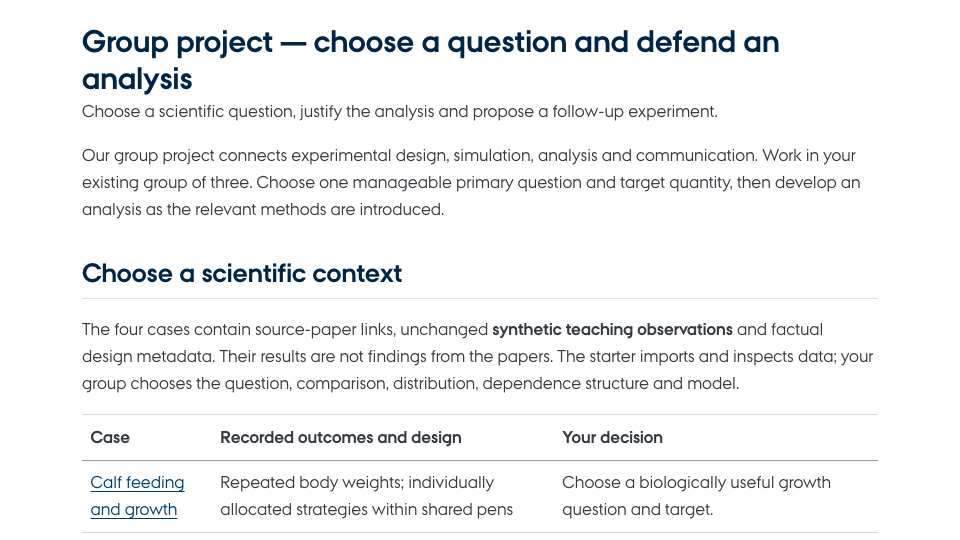
Choose a scientific question, justify the analysis and propose a follow-up experiment.
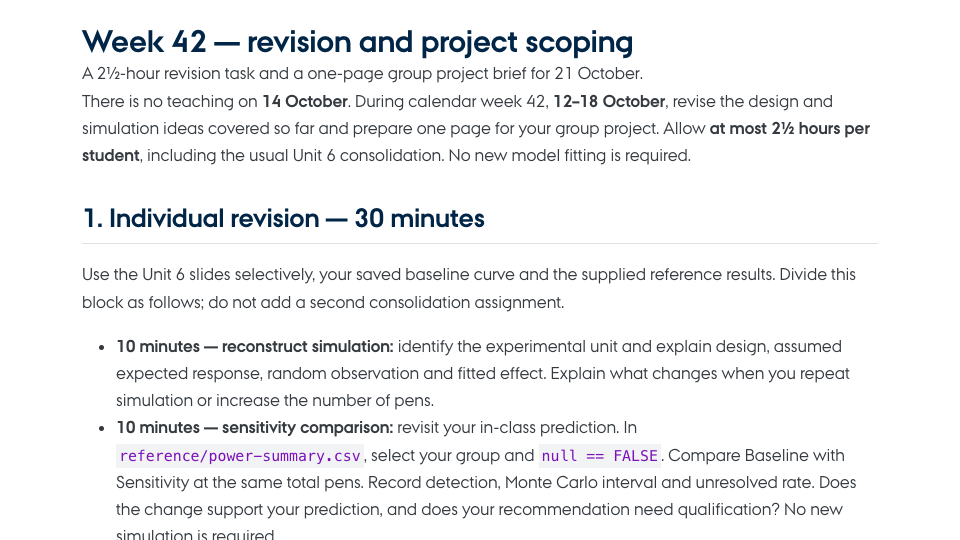
A 2½-hour revision task and a one-page group project brief for 21 October.
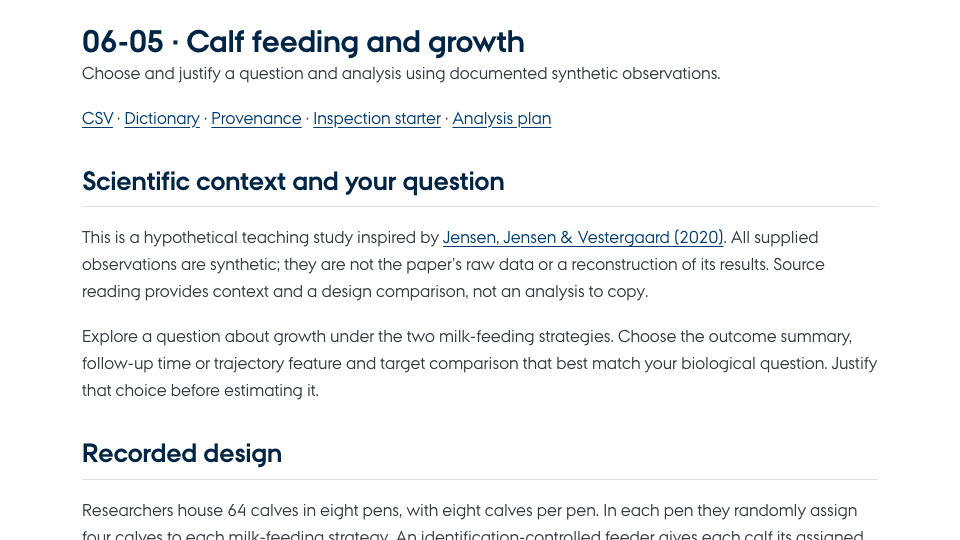
Choose and justify a question and analysis using documented synthetic observations.
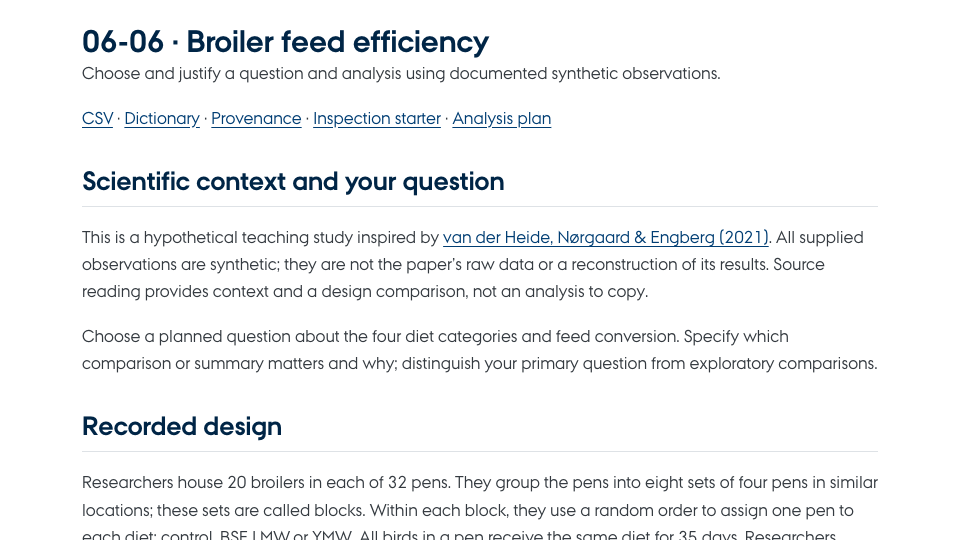
Choose and justify a question and analysis using documented synthetic observations.
Choose and justify a question and analysis using documented synthetic observations.
Choose and justify a question and analysis using documented synthetic observations.
Work through pen-study examples, interpret output and check another group’s answers
Plain-language explanations of the model terms, output columns and diet comparisons
Practise explaining predictions and interactions, then consider animals sharing a pen
Identify treatment assignments, fit models and explain direct package output.
Use a yes/no model and plan a future pen trial with simglm.
Use the experiment, fitting output and plots to justify an action and check again.
Consolidate a defensible diagnostic report and introduce repeated measurements.
Read the output from two count models and decide what the evidence supports.
Check whether gains from animals in the same pen share a pattern.
Check a straight-line relationship and decide whether to fit a curve.
Check a logistic fit and decide what the observed screen rates support.
Trace gains from the same animal and identify the conditions shared within pens.
Use lme4, performance and marginaleffects directly to analyse repeated calf weights and a cow crossover.
A 60-minute follow-up using direct package calls, a calf change comparison, and crossover assumptions.
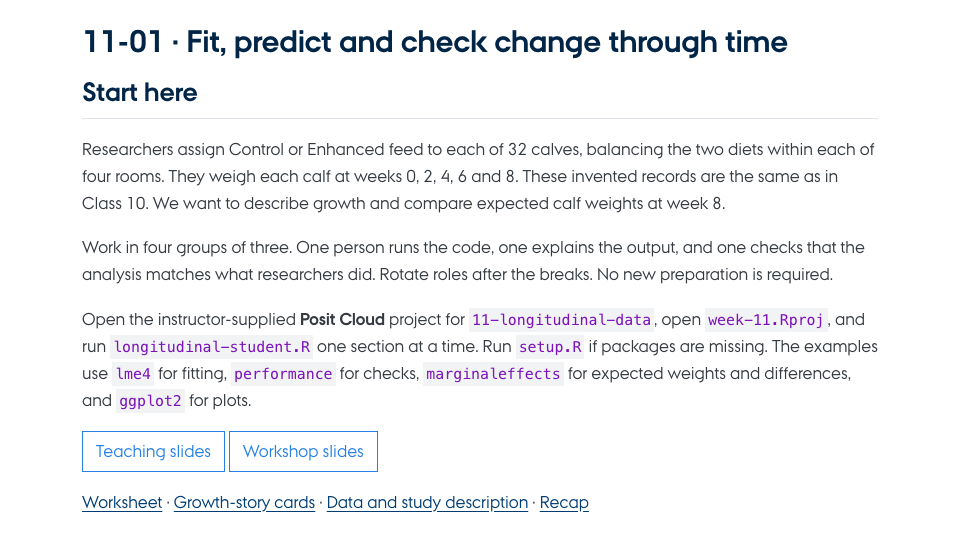
Researchers assign Control or Enhanced feed to each of 32 calves, balancing the two diets within each of four rooms. They weigh each calf at weeks 0, 2, 4, 6 and 8. These…
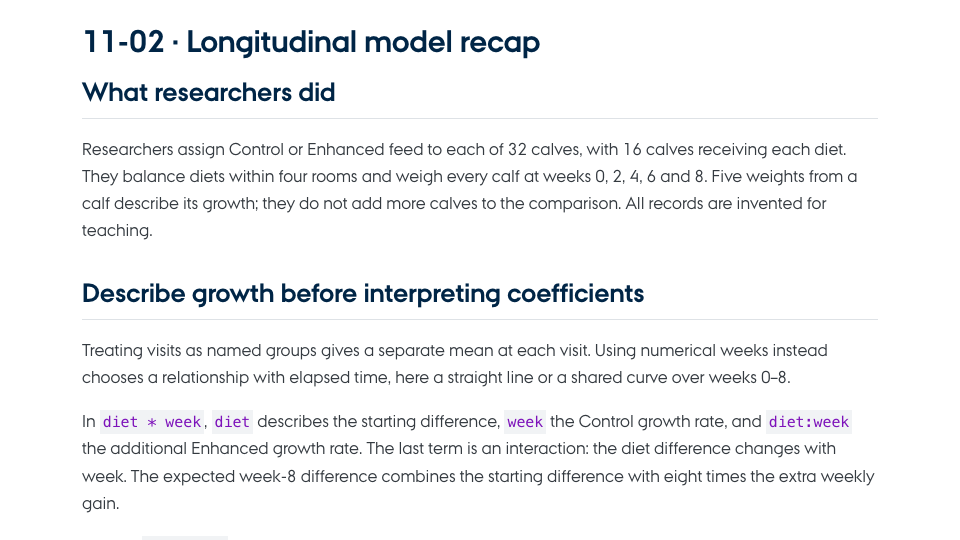
Researchers assign Control or Enhanced feed to each of 32 calves, with 16 calves receiving each diet. They balance diets within four rooms and weigh every calf at weeks 0…
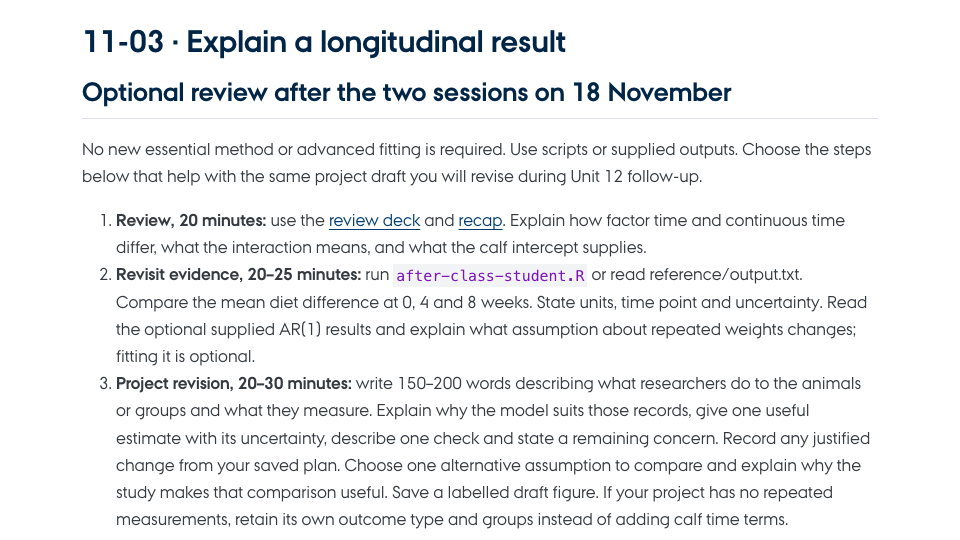
No new essential method or advanced fitting is required. Use scripts or supplied outputs. Choose the steps below that help with the same project draft you will revise during…
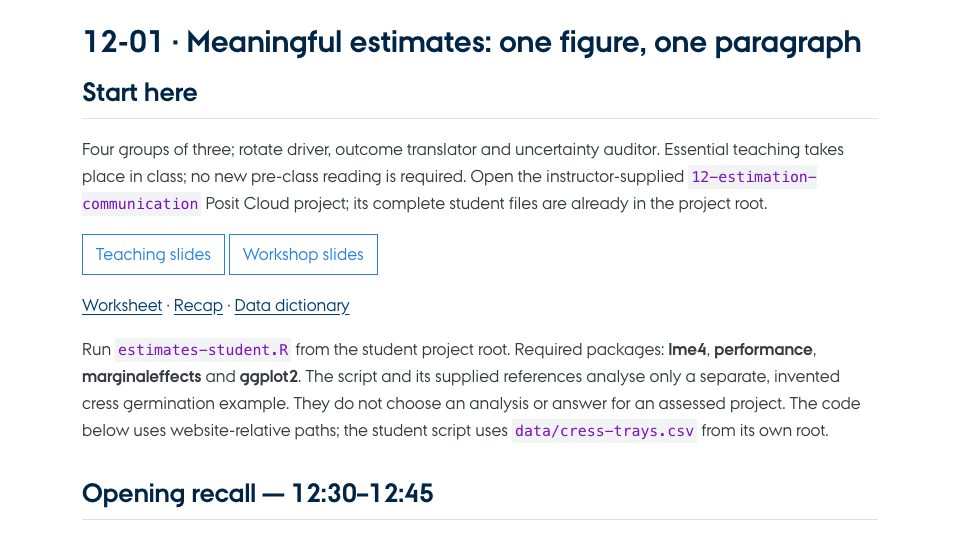
Four groups of three; rotate driver, outcome translator and uncertainty auditor. Essential teaching takes place in class; no new pre-class reading is required. Open the…
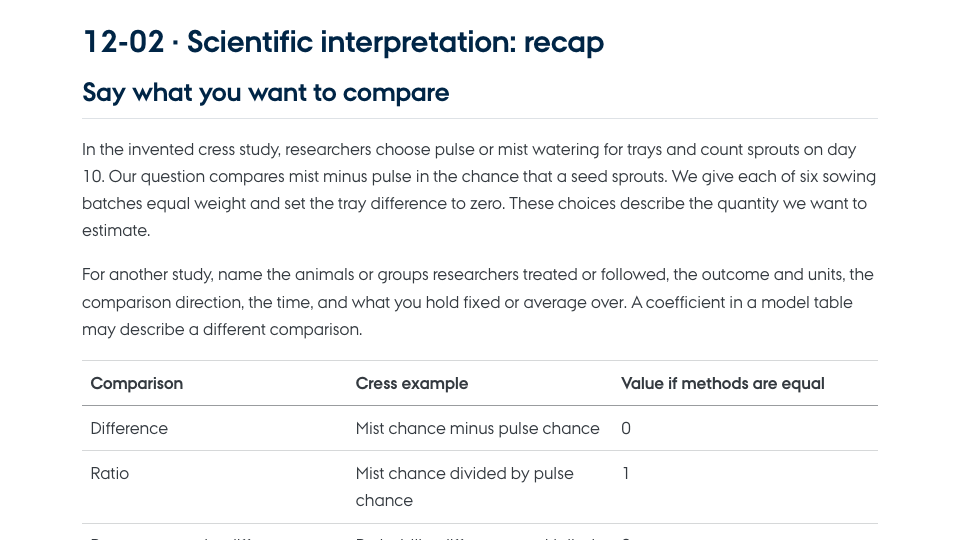
In the invented cress study, researchers choose pulse or mist watering for trays and count sprouts on day 10. Our question compares mist minus pulse in the chance that a…
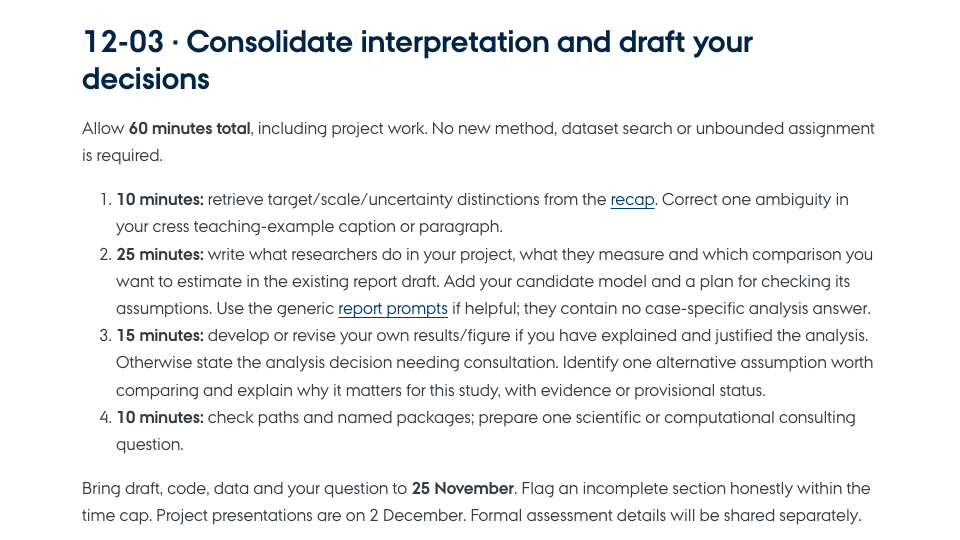
Allow 60 minutes total, including project work. No new method, dataset search or unbounded assignment is required.
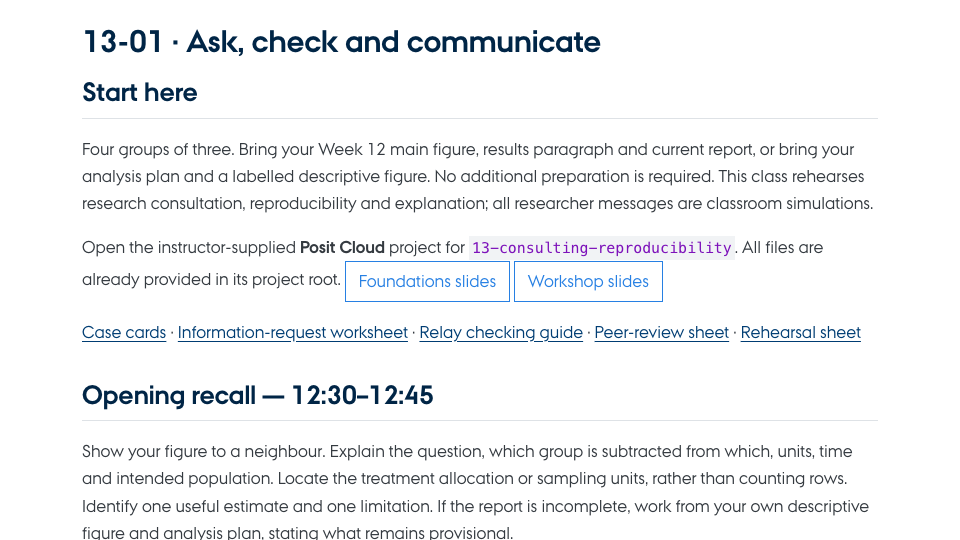
Four groups of three. Bring your Week 12 main figure, results paragraph and current report, or bring your analysis plan and a labelled descriptive figure. No additional…
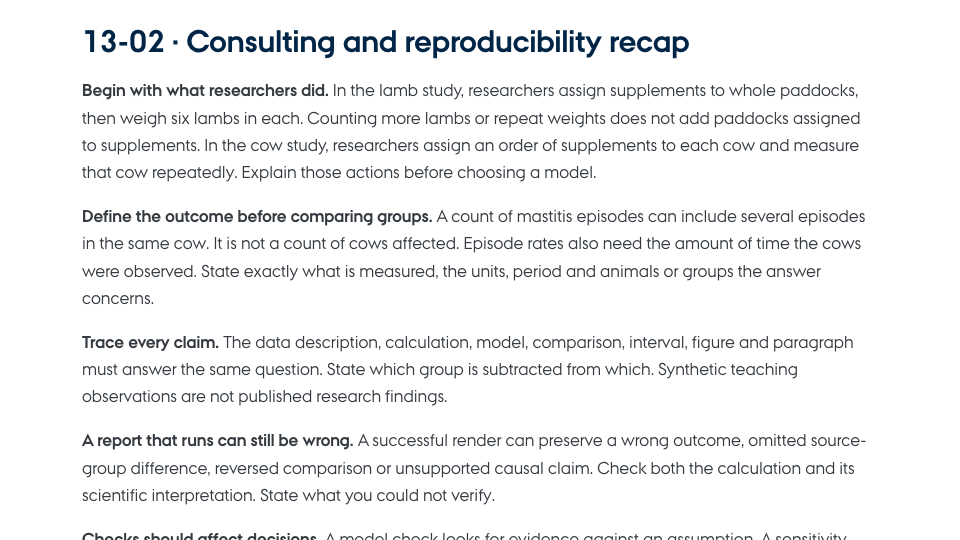
Begin with what researchers did. In the lamb study, researchers assign supplements to whole paddocks, then weigh six lambs in each. Counting more lambs or repeat weights…
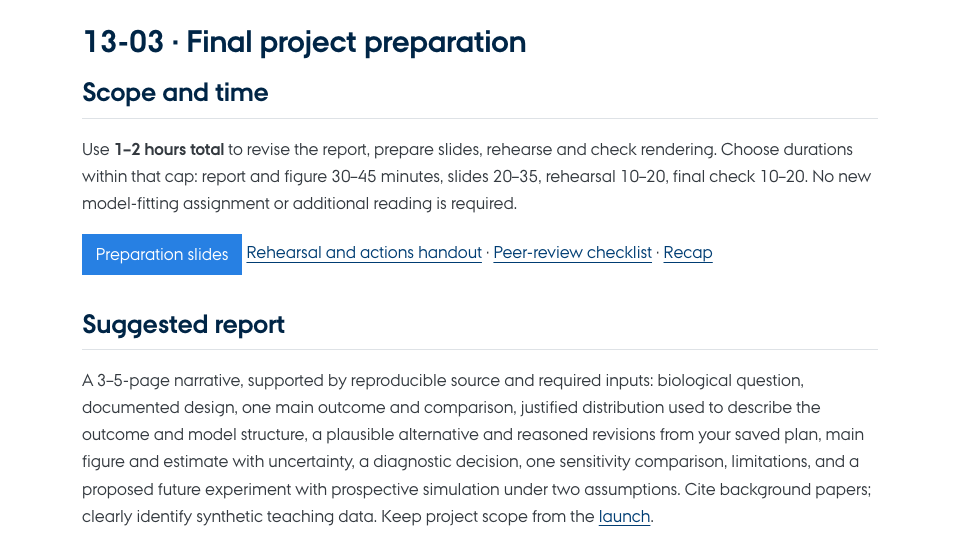
Use 1–2 hours total to revise the report, prepare slides, rehearse and check rendering. Choose durations within that cap: report and figure 30–45 minutes, slides 20–35…
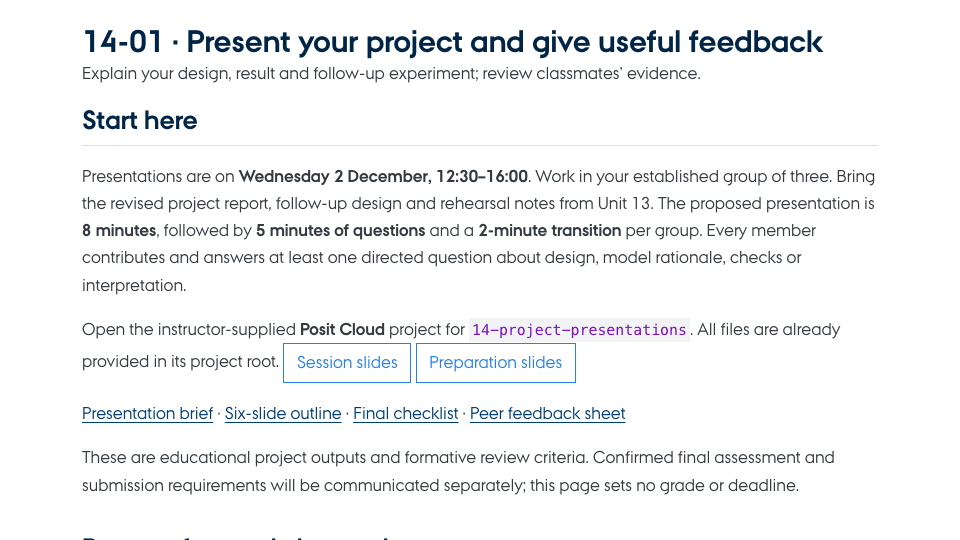
Explain your design, result and follow-up experiment; review classmates' evidence.
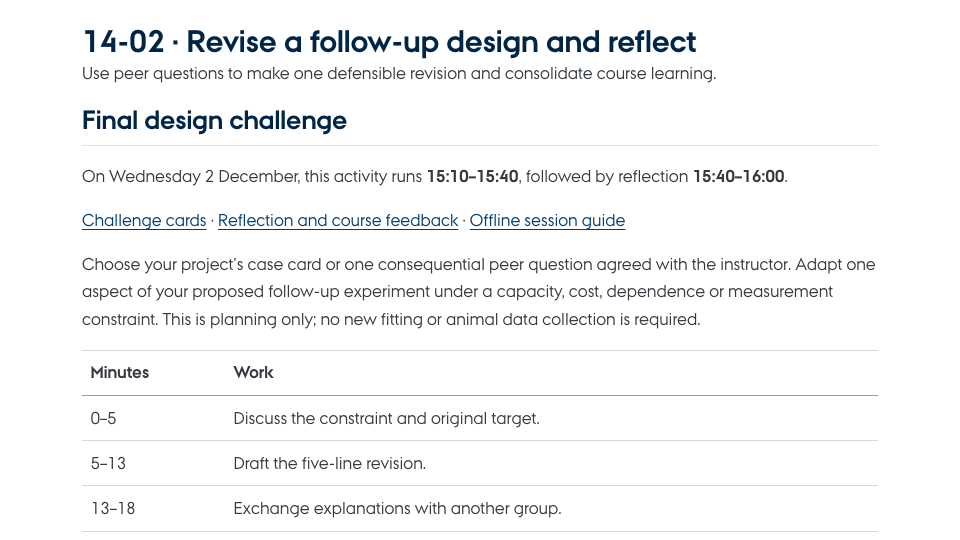
Use peer questions to make one defensible revision and consolidate course learning.